“Will it feel the same?”
“Will it actually work?”
“Isn't it a bit impersonal?”
“Will I be able to open up through a screen?”
“What if someone at home overhears?”
If you're thinking about counselling and have been offered sessions online, you may well be asking yourself these questions.
Since the COVID-19 pandemic, online counselling has become a normal part of how therapy is offered (Ebrahimjee et al., 2024). Many counsellors now work online, and some only offer online sessions. But many people still wonder whether talking to someone through a screen can help.
What online counselling actually involves
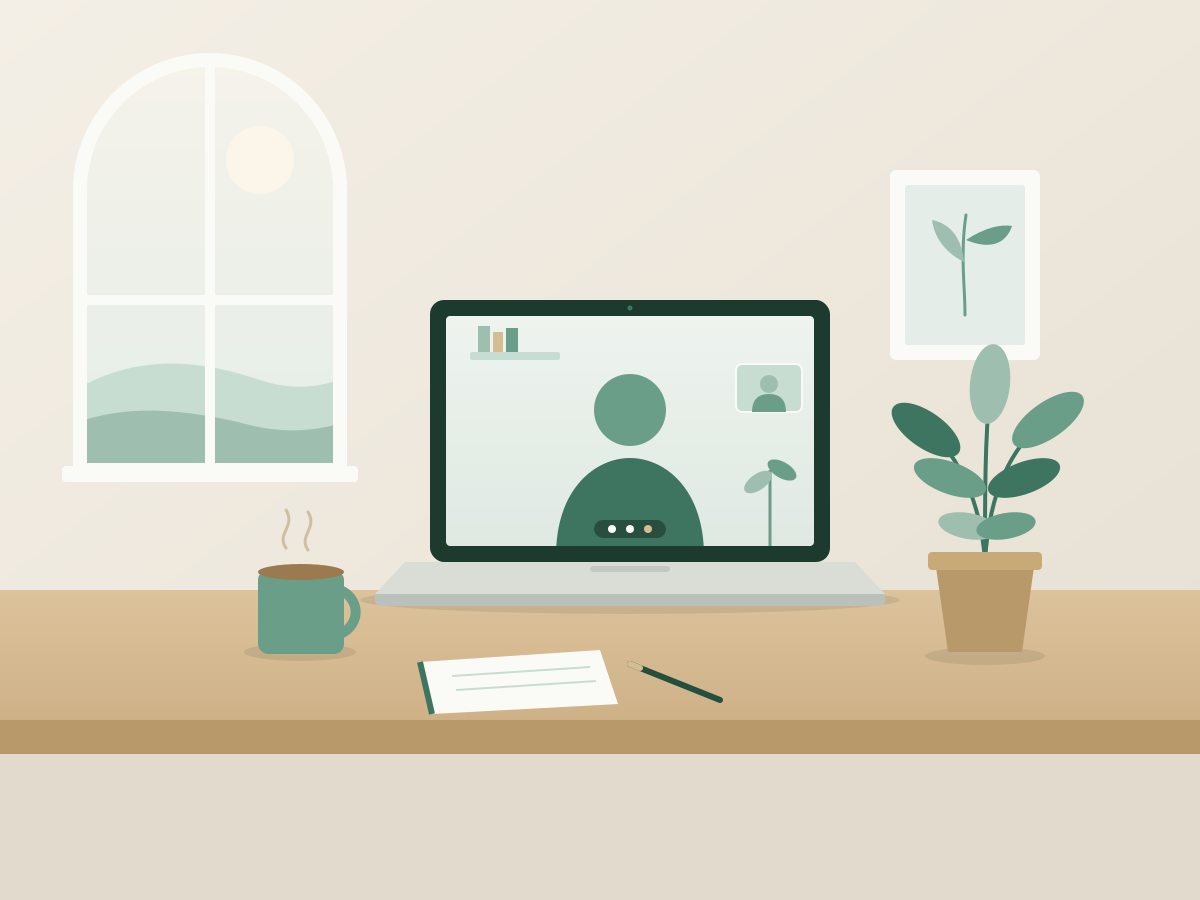
Online therapy is typically offered as scheduled sessions with a qualified counsellor by secure video, usually lasting 50 minutes. It's worth recognising that this is different from using a mental health app or other self-help programmes, as you talk in real time with a qualified professional, usually at the same time each week.
A qualified counsellor working online follows the same ethical standards as one working in a room. Your sessions are confidential, your counsellor will receive regular monthly clinical supervision, and they should be registered with a professional body. In the UK, bodies such as the National Counselling and Psychotherapy Society (NCPS) and the British Association for Counselling and Psychotherapy (BACP) hold accredited registers which are overseen by the Professional Standards Authority (PSA). NCPS and BACP members follow their professional body's code of ethics wherever they work, and BACP also publishes specific guidance for counsellors on working safely online (BACP, 2015, 2022; NCPS, 2023).
Does it work? What the research says
For most people, the research suggests online counselling works just as well as meeting in person.
A large meta-analysis combined the results of 47 studies which involved more than 3,500 people. This review found that online therapy worked clearly better than waiting for help and made almost no difference to how much people gained from therapy compared with meeting face to face (Fernandez et al., 2021). Other reviews have reached similar conclusions for depression (Giovanetti et al., 2022) and for common difficulties such as anxiety (Ebrahimjee et al., 2024).
However, much of this research has looked at cognitive behavioural therapy (CBT), which is a readily available and structured, goal-focused approach. The strongest results have been for anxiety, depression and post-traumatic stress (Fernandez et al., 2021). There is less research on other styles of counselling, such as person-centred or integrative approaches. This doesn't mean they work less well online, only that fewer studies have been done.
“But will I feel connected?”
When looking for therapy, particularly if this is a new experience, this is often people's biggest worry. The relationship between you and your counsellor, professionally known as the therapeutic alliance, is widely seen as one of the most important parts of counselling.
Findings on this have shifted as online therapy has become more accessible and better known. An early review found good working relationships in every study it looked at. People rated the relationship slightly lower online, yet their symptoms improved just as much (Norwood et al., 2018). The researchers suggested this might partly be because the questionnaires used to measure the relationship were designed for face-to-face therapy.
More recent studies have been more positive; for example, a 2024 review found no meaningful difference in the strength of the relationship between video and in-person therapy, whether clients or counsellors were doing the rating (Seuling et al., 2024). Another study found that, just as in the counselling room, a stronger relationship online tends to go hand in hand with better outcomes (Norwood et al., 2021).
Therefore, the evidence strongly suggests that it is possible to build a good relationship with a counsellor over video. It can take a session or two to feel natural, and you can always discuss with your counsellor how it's going and make amendments where necessary; it is your therapy after all.
Why some people prefer online counselling
For some people, the appeal is practical: there's no requirement to travel and therefore no extra time or cost on top of the session itself. Online sessions can also be easier to fit around work, childcare, health conditions or other family commitments, and many counsellors who work online offer evening or weekend appointments. For people with limited mobility or no easy transport, online sessions may be the only realistic way to get counselling.
For others they may feel more at ease when being vulnerable in their own space. In one small study, clients particularly valued the flexibility of online therapy and the way it allowed their counselling to continue without interruption (Donkin, Jones and Van Kessel, 2026). This matters because online therapy can open up counselling to people who may find it hard to attend in person for whatever reason.
The psychologist John Suler observed that people often find it easier to open up when communicating online compared to face to face; he called this “benign disinhibition” (Suler, 2004). His work looked at online communication in general rather than counselling specifically, and not everyone experiences it. But if walking into an unfamiliar room feels daunting, talking from somewhere familiar can take some of the pressure off.
Online counselling also gives you more choice. You're not limited to counsellors who happen to be nearby, so you can look for someone whose experience and approach suit you best.
When it might not be the best fit
Online counselling doesn't suit everyone, and there are a few things to consider.
Privacy at home. If you share your home, it may be hard to find somewhere you can talk freely without being overheard. If you don't feel safe talking openly at home, it's worth mentioning this to a counsellor so you can find another option together.
Body language. People who have tried online therapy notice that body language and other non-verbal cues can come across less clearly on screen (Donkin, Jones and Van Kessel, 2026). Your counsellor may check in with you more often about how you're feeling, rather than relying on what they can see.
Switching off afterwards. Going straight from a difficult session back to the home environment can feel abrupt. Clients describe small routines before and after sessions as helpful (Donkin, Jones and Van Kessel, 2026).
Technology. Counsellors report that platforms, internet connections and access can all cause problems (Buckman et al., 2021). You'll need a reasonably reliable connection and a laptop, tablet or phone.
Crisis support. Online counselling isn't an emergency service. If you're at serious risk, face-to-face or more intensive support may be safer. Counsellors working online will usually ask where you are during sessions and for an emergency contact.
Staying in. If part of what you're struggling with is leaving the house or being around people, counselling entirely from home could sometimes make that pattern harder to change. It's worth discussing this with your counsellor.
And some people simply prefer therapy to happen somewhere other than home. That is reason enough to choose face-to-face sessions.
Making online sessions work for you
A few practical steps can help:
- Find a private spot. A bedroom, a spare room or even a parked car can work. Headphones help, and a fan or white-noise app outside the door can stop others overhearing.
- Use a laptop or tablet if you can. A bigger screen makes it easier to sit back and feel present. Keep it charged or plugged in.
- Give yourself time before and after. Even five minutes to settle in, and a short walk or a cup of tea afterwards, can help you move between your session and the rest of your day.
- Agree a backup plan. Ask your counsellor what will happen if the connection drops.
- Have water and tissues to hand, just as you would find in a counselling room.
Questions to help you decide
These questions may help you think it through:
- Do I have somewhere private where I can talk for an hour without being overheard?
- Would I find it easier or harder to open up at home?
- Do travel, cost, health or timing make face-to-face sessions difficult?
- How do I usually feel on video calls?
- Would I rather keep counselling separate from home?
- Am I safe right now, or do I need more immediate support?
You don't have to commit straight away. Many counsellors offer a free introductory call, which is a good chance to see how talking online feels. Once you've started, you can review with your counsellor how the format is working for you.
To conclude
The research suggests that, for many adults, online counselling works just as well as meeting in person, and that a real connection with a counsellor, known as the therapeutic alliance, can form remotely. The evidence is strongest for CBT, and more research on other approaches is needed. Online therapy won't suit everyone, but for many people it makes support easier to reach and can remove barriers to accessing therapy.
References
- BACP (2015) Good Practice in Action 047: Working online in the counselling professions. Lutterworth: British Association for Counselling and Psychotherapy. Last reviewed 2025.
- BACP (2022) Good Practice in Action 125: Working online in the counselling professions (clinical reflections for practice). Lutterworth: British Association for Counselling and Psychotherapy. Updated 2024.
- Buckman, J.E.J., Saunders, R., Leibowitz, J. and Minton, R. (2021) ‘The barriers, benefits and training needs of clinicians delivering psychological therapy via video’, Behavioural and Cognitive Psychotherapy. doi:10.1017/S1352465821000187
- Donkin, L., Jones, A. and Van Kessel, K. (2026) ‘Client experiences of videocall-delivered therapy during COVID-19 restrictions in Aotearoa New Zealand: a qualitative study’, Counselling and Psychotherapy Research, 26, e70124. doi:10.1002/capr.70124
- Ebrahimjee, A., Hodsoll, J., Valmaggia, L., Hickling, L.M. and Riches, S. (2024) ‘Video call-based cognitive behaviour therapy for adults with common mental health conditions: a systematic review and meta-analysis’, The Cognitive Behaviour Therapist, 17, e42. doi:10.1017/S1754470X2400028X
- Fernandez, E., Woldgabreal, Y., Day, A., Pham, T., Gleich, B. and Aboujaoude, E. (2021) ‘Live psychotherapy by video versus in-person: a meta-analysis of efficacy and its relationship to types and targets of treatment’, Clinical Psychology & Psychotherapy, 28(6), pp. 1535–1549.
- Giovanetti, A.K. et al. (2022) ‘Teletherapy versus in-person psychotherapy for depression: a meta-analysis of randomized controlled trials’, Telemedicine and e-Health, 28(8), pp. 1077–1089. doi:10.1089/tmj.2021.0294
- National Counselling and Psychotherapy Society (NCPS) (2023) Code of Ethics and Professional Practice. Available at: https://ncps.com/about-us/code-of-ethics (Accessed: 29 October 2026).
- Norwood, C., Moghaddam, N.G., Malins, S. and Sabin-Farrell, R. (2018) ‘Working alliance and outcome effectiveness in videoconferencing psychotherapy: a systematic review and noninferiority meta-analysis’, Clinical Psychology & Psychotherapy, 25(6), pp. 797–808. doi:10.1002/cpp.2315
- Norwood, C., Sabin-Farrell, R., Malins, S. and Moghaddam, N.G. (2021) ‘An explanatory sequential investigation of the working alliance as a change process in videoconferencing psychotherapy’, Journal of Clinical Psychology, 77(6), pp. 1330–1353. doi:10.1002/jclp.23112
- Seuling, P.D., Fendel, J.C., Spille, L., Göritz, A.S. and Schmidt, S. (2024) ‘Therapeutic alliance in videoconferencing psychotherapy compared to psychotherapy in person: a systematic review and meta-analysis’, Journal of Telemedicine and Telecare, 30(10), pp. 1521–1531. doi:10.1177/1357633X231161774
- Suler, J. (2004) ‘The online disinhibition effect’, Cyberpsychology & Behavior, 7(3), pp. 321–326.